
I ring the buzzer a second time, and once again an automated voice fills the air around shelves of mascaras, protein shakes, eye drops, seasonal chocolates, Scotch tape, and the pharmacy counter: “All available associates: customer service requested in hair care.”
All available associates, my brain scoffs. I’ll be surprised if there’s more than the cashier working in this drugstore at 4 p.m. on a Tuesday.
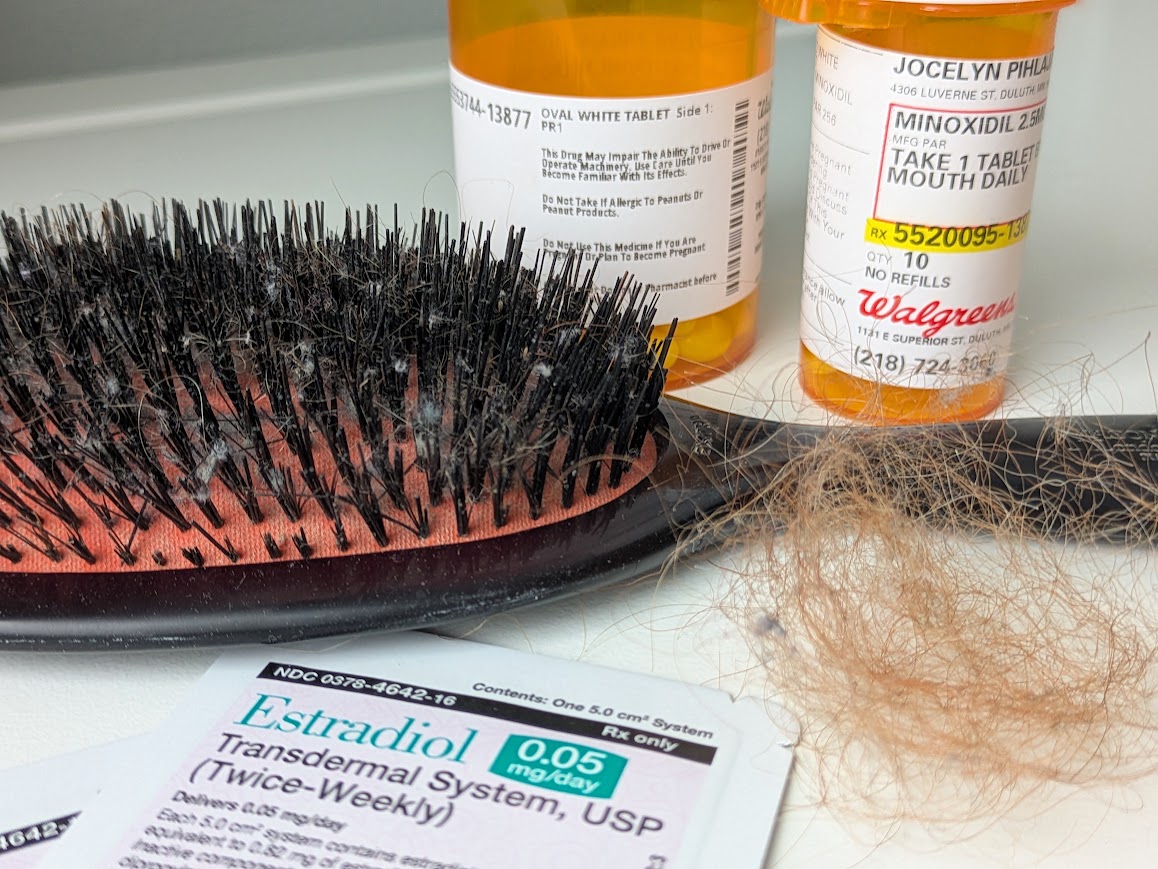
Why can’t they have more staff? Damn it, Capitalism. The way you keep everything lean to the bone in service of profits – I’m whiny because I’m embarrassed, standing as I am next to a locked case of “hair regrowth treatment,” waiting for a stranger with a key to show up and release the Women’s Rogaine into my clammy palm.
It’s a strange dynamic, this business of paying a chunk of money for something I don’t want and don’t, technically, need.
It feels like a need, though, emotionally, psychologically, even physically. The last six months have been rough.
Neither the internet nor my reluctantly prescribing primary physician had mentioned that starting menopausal hormone therapy might trigger hair fall so steady that within three months of slapping on the first estrogen patch and downing a daily 100 milligrams of micronized progesterone, I’d have lost a third of my hair.
Until I interfered with it, menopause had been easy. Although 75% of menopausal women experience night sweats and hot flashes that dramatically impede quality of life, for me, at most, I’d experienced gentle warming and cooling throughout my days for a year or two, most notably at night before bed while watching Netflix with my husband. Eventually, I realized those light temperature changes were happening frequently, sometimes 2-3 times per hour; that realization, in turn, allowed me to register that hundreds of temperature fluctuations a day were low-key exhausting.
But still. I felt good? My mood was upbeat; I had energy; I felt strong. During my annual physical when I was 56, the doctor, a 60-year-old woman, quickly noted that I’d finally met the technical definition of menopause before moving on to a referral for the pain in my knee. If the doctor didn’t see anything worth talking about related to the end of menstruation, that must have meant I passed?
Certainly, in subsequent years, my recall and ability to track information got noticeably shaky, with family having to remind me where my stories were going or what point it seemed I was intending to make. Never, though, did this strike me as something called “brain fog.” Rather, when I added yet another Post-it note to the kitchen counter—a jotting of “reminders” for the next few days because tracking three things felt like too much—I would, only half-jokingly, mutter that I must be developing early dementia.
So my brain was a colander, sometimes my body decided to preheat, and, yes, I had developed a stiff toe, chronic tennis elbow, knee pain, fire in my lower back, itchy skin, high cholesterol, tinnitus, and the ability to awake at 3 a.m. and stare at the darkness until sunrise, but all that, it seemed, was just part of having a body that had been in motion since The Turtles “Happy Together” hit #1 on the charts.
Without hot flashes or night sweats, I wasn’t suffering the vasomotor symptoms of menopause.
I was fine.
It was during the summer of 2024 that my cousin’s wife, an evidence-driven physical therapist, sent the message that started a change in my relationship with myself:
I’m on a mission to educate all the similarly aged women in my life that they should be on hormone replacement therapy. I don’t think I’ve talked with you about this. And no surprise, I have some strong opinions. Like so, so many other things around women’s health, this is a subject where most doctors are failing horribly.
She went on to explain the misinterpretation of the long-term Women’s Health Initiative study that linked the use of oral equine-conjugate estrogen + medroxyprogesterone acetate to increased rates of breast cancer, heart disease, stroke, and blood clots. Before the media blast of alarming headlines in 2002 when the WHI discontinued the study, citing an unacceptable level of risk for participants, roughly 40% of menopausal American women used MHT. After the explosion of fear and outrage in 2002, doctors stopped prescribing MHT, medical schools stopped teaching it, pharmacies stopped filling it, and only 4% of American women used it. The hormone heyday, it seemed, was over.
It was into this desolate landscape that I stepped more than twenty years later, wide-eyed and unarmed. My doctor hadn’t mentioned hormones when we talked about menopause, but my cousin’s wife was urging me to question the persistent fallout of the WHI study. Decades had passed, new forms of estrogen and progesterone had been developed, alternate methods of administration were available, and the ruinous WHI study results had been re-examined, revealing that, in fact, women under the age of 60 with fewer than ten years since their last periods had not evidenced higher rates of life-threatening diseases when on MHT. Initially, the study had lumped together the results of all participants (ranging in age from 50-79), thus equating the outcomes of women nearing 80 with those nearly thirty years younger. What had been lacking in study interpretation and subsequent media coverage was nuance. It wasn’t that hormones were dangerous; rather, their use needed to be tailored to every woman’s specific history, biology, lifestyle, and sense of self.
(Part Two coming tomorrow!)
Leave a Reply