
I’m a persnickety reader. While I enjoy all sorts of books, I lean heavily into fiction, and I’m always in search of glorious sentences more than anything. Many readers are propelled by plot, but for me, style is paramount, followed by characterization. A clever structure doesn’t hurt either. And for sure, originality energizes.
Beyond personal preferences, I respect readers who recoil from the Jodi Picoults of the authorial world, who scorn the precious conceits of books like The Midnight Library, who push themselves to read books written from perspectives dramatically different from their own. (tldr: white people should read authors of color A LOT)
That said, one of my favorite things to do is match the right book with the right person; if it offered benefits and a livable wage, I’d love to be a Book Concierge. Successfully pairing reader and book requires that the recommender see the reader for who they are rather than indiscriminately tossing out titles the recommender has personally enjoyed. What I like in a book may not suit or satisfy the individual looking for their next absorbing story. As with all things, success boils down to audience awareness.
So, with those caveats laid out, I offer a rundown of my favorite reads of 2025. Perhaps something on this list will appeal to who you are, or perhaps you’ll find an idea for a gift for Your Cranky Aunt.
4 and 5-Star Reads
Clear – Carys Davies
Although this novella fulfills is promise entirely, I was disappointed when it ended – because I wanted MORE. The characters are real and interesting, the setting arresting (1843 on a remote Scottish island, when the Highland Clearances were allowing landlords to evict longtime residents from their lands), and the potential of further plot tantalizing. WHAT HAPPENS AFTER THE LAST PAGE HELP I NEED TO KNOW HOW IT GOES FOR MY NEW FRIENDS
In short: The prose is crystalline; I swear, my hair started blowing around my head as I sat in my blue chair and imagined myself standing next to loner Ivar on a cliffside overlooking the North Sea.
The Buffalo Hunter Hunter* – Stephen Graham Jones
I’m wild for this author and his latest work. It’s his best yet? There’s an ease and confidence to his storytelling in this book (technically horror, but trust: I am not a horror reader as a rule); in it, he manages to convey the brutal treatment of Native Americans on the Plains under settler colonialism in a way that feels fresh and gaaaaaaaahhhhhh impactful.
In short: This is my #1 read of the year, and Byron and I would welcome Stephen Graham Jones into a marriage of three.
Endling – Maria Reva
You’ve not read a book like this before – unless you’ve previously read a story set in Ukraine at the moment Russia invaded in 2022 about a woman intensely dedicated to snail preservation and with a hearty subplot about the marriage market that positions Eastern European women products to be consumed by awkward Western men.
In short: malacologists are heroes, and I cried at the wildly absurd and touching scene when two nearly extinct snails found each other. Also, Ukrainians are scrappy asf.
Dusk* – Robbie Arnott
Oh, hey, here’s another book during which I had a big cry, this time over a problematic puma being hunted in the highlands of Tasmania and a pair of hard-scrabble twins hoping to earn the bounty. Despite reading like a good old-fashioned Western, the subtext is clearly anti-colonization. I mean, there are some good waterfall scenes, too.
In short: You might like pumas on your feet or in cages, but the world will never be right until we allow them their place.
The Compound – Aisling Rawle
If you don’t have a good understanding of and appreciation for reality tv shows aimed at manufacturing “connections” between women with breasts that don’t move and men who play semi-professional sports, this book is likely not for you.
However. If the words “dumped from the villa” and “Can I pull you for a chat?” get your heart thrumming, this rough and insightful story of young people in the dystopian near-future using a tv program as a way to gain not only fame, but also the hope of a future, might be a good fit.
In short: When a fluffy topic is treated smartly, the result can be sharp.
The Hounding – Xenobe Purvis
If the Salem witch trials are endlessly fascinating to you as an historical example of the persistent persecution of women, the tenor and events of this short novel might land right. Rumors and judgmental townspeople conspire to punish a tight family of sisters for daring to exist a few degrees outside of the norm in 17th C. England.
In short: The fact that the setting is the 17th C. is irrelevant, given the way the desire to punish women drives current public policy. As ever, fiction conveys truths more accurately than facts.
Greenwood* – Michael Christie
Although I emptied my ducts for snails and pumas this year, still, I had tears for trees. This multigenerational novel tracks the devastation of empire building through cross-sections of a single family in five different years (spanning 1908-2038). Storytelling and structure shine in this ode to the forests that could save us, if only we’d save them.
In short: I had to flip back and forth from middle to start and reread sections as I gained better understanding of the characters and their secrets. Holding and working with the paper pages as I did this felt appropriate to the heart of the novel.
A Gorgeous Excitement – Cynthia Weiner
Not sure if you have to be Gen X to enjoy this book as much as I did, but maaaaaan, did it take me back to 1986 and make me want to smoke a clove cigarette while resting a bottle of Peachy Riunite on the leg of my button-front Levi 501s. The setting is the bars, parks, and heat of NYC in the summer before the protagonist starts college. All she wants is to lose her virginity, but bigger events and lessons are served during that specifically wild moment of Madonna-emerging-coke-everywhere-CBGB-the-coolest.
In short: I’d forgotten about The Preppy Murder before cracking into this one; the way we all were collectively riveted by that horrific crime feels weirdly like something we’ve now lost?
The Book of I* – David Greig
Here’s another novel that is wholly distinctive and original, perhaps because it was written by a Scottish dramatist. The year is 825 CE, and Viking raiders ambush a small island off the coast of Scotland, massacring nearly everyone. What you need to know, if you think you don’t like violent, stressful books, is that this story is simultaneously funny and so, so charming. I’m a little in love with mute Una, the beekeeper and mead-maker.
In short: If books were illegal at airports, I’d tuck this one up my cooch and not flinch in the face of TSA questioning.
The Wedding People – Alison Espach
In the 1990s, the term “chick lit” was used for books that focused on women in emotional crisis and/or trying to figure out their love lives. By that definition, this story of a woman who arrives at a hotel with the intention of killing herself but then gets caught up in the swirl of a bride and her guests is classic chick lit. For me, while I rather object to the ease with which our heroine moves from “I want to die” despair to “Life is beautiful” appreciation, I also concede that Espach writes with enough thoughtfulness and depth to pull off the trick.
In short: The masses love this book for a reason.
Isola – Allegra Goodman
I am not religious, but if such a thing as heaven exists, I hope for me it’s a place where I can sit in a movie theater with a bottomless bucket of perfectly buttered popcorn and watch every single bit of history for every human who’s ever existed, from the moment the first hominoid realized the potential for upright walking.
In my heaven, I’d be able to zoom in on and dwell longer with particularly interesting lives, such as that of Marguerite de la Rocque de Roberval, upon whose life this novel is loosely based. Goodman effectively imagines the circumstances that might have led a 16th C noblewoman to be marooned for several years on an island off Canada; the novel in itself is satisfying, but it makes me wish I could know exactly how she did it. Dude, it seems likely there were, indeed, polar bears on the island during the frozen months. Not only is this story a study in isolation, it’s a dig into what it means to be “feminine” and “female” in a world indifferent to gender.
In short: Send me all your suggestions of great survivor books. I quite literally am someone who regularly games out how long she could stay alive in her own backyard, should it become her only food source. We have deer, we have squirrels, we have racoons, we have apples, we have garlic, we have questionable not-harvested-for-a-decade asparagus, we have raspberries, we have the occasional bear. I feel like I could make 90 days? (A full year, if I were allowed to scavenge from the garbage of the five young lads who live across the way whenever the squirrels pull it from the bin and scatter it down the alley)
Audition – Katie Kitamura
It’s lovely to rest in the hands of an accomplished author, someone who can play successfully with structure and create a result that holds the reader while challenging them to question what’s real. The tenor of this book for me was both controlled and muted; I didn’t feel there with the characters but more that I was watching their performances with each other – which seems to be part of Kitamura’s aim. As I worked through the two-part structure, my interest held because I was trying to figure out who the characters are to each other and, by extension, who we all are to each other, depending on circumstances.
In short: This read is more of a thought exercise than an emotional journey. I respect it, but it doesn’t live in my heart.
The Silver Bone* and Stolen Heart* – Andrey Kurkov
Am I periodically checking the internet to see if book #3 in this series has been released yet? Does Byron have a “watch” placed at the library so he’ll be notified when the next book is published and translated?
The “more please” implied by those questions is our saliva-drenched compliment to Kurkov’s ability to write mysteries that are wildly evocative of place and time (Kyiv, 1919, just after WWI has finished, when competing factions are vying for control of Ukraine – HELLO, BOLSHEVIKS AND INITIAL RISE OF SOVIETISM, among other parties creating chaos). I don’t think I’ve ever read a mystery more effective in conveying the atmosphere of a time and place. Also a standout is the characterization, with protagonist Samson a bumbling, charming naif taking lurching steps into a new world order that changes by the day.
In short: I wouldn’t say I totally followed the mystery part of these books because I was so saturated already by the small details and emerging mores of 1919 Kyiv. It’s like I didn’t have the capacity to care overmuch about the “whodunit” aspect. (I’ve always been a problematic mystery reader. If the book doesn’t grab me in other ways, I’m likely to shrug and set it aside.) In the case of these books, Kurkov could leave out the detective story entirely, and I’d still crawl on all fours, wincing every time my bum fucking knee hit the floor, to snatch up his next release.
The Husbands – Holly Gramazio
This book, too, would’ve been called “chick lit” back in the day, as it’s definitely aimed toward women who are socialized to believe the happiness and satisfaction of their lives hinge on finding and marrying The One. Readers uninterested in that thinking needn’t bother with this one, as it’s about a single woman whose attic suddenly starts turning out husbands for her – a different man emerges each time the current husband goes up to change the lightbulb. Since I have an ongoing interest in how random the concept of “soulmate” is and how profoundly individuals are shaped by the people they choose as lifelong partners, this premise worked for me. Even more, I appreciated the final takeaway: that no one person is the perfect partner, and committing to someone for the long term is a series of tradeoffs and acceptance of flaws.
In short: A good beach read – lightish and an interesting conceit.
Woodworking* – Emily St. James
Listen, this novel feels like what it is: the author’s first book. But I enjoy reading emerging writers and getting a whiff of their promise, and because St. James is doing important writing, I’m willing to overlook the weaker moments of improbability (i.e. a high school teacher stepping into their own transness by learning “how to do it” from a trans student; so many boundaries are crossed!).
We need books like this one. We need books set in small towns like Mitchell, South Dakota, that present vivid, complex characters claiming their right to be who they are in a place where it can be dangerous to be different.
In short: Don’t get hung up on the bits that feel like too much (“Excuse me, is everyone in this town trans?”) and roll with the heart and joy of characters stepping into their fullest selves.
All the Little Bird-Hearts – Viktoria Lloyd-Barlow
As I toppled into this wonderfully voiced book, I kept thinking of people like my mom (Silent Generation, late-in-life fan of Fox News) and how they would, at best, perceive the charming protagonist as “an odd bird.” Indeed, without an understanding of neurodivergence’s many forms – and how folks with differently gifted brains are, in truth, as ubiquitous as neurotypicals – many readers might not know what to make of main character Sunday, an autistic mother who loves her daughter fervently. As both mother and daughter fall in thrall to their glamorous, cosmopolitan new neighbors, sympathetic readers feel faintly panicked for Sunday. Her way of being keeps her too pure for a world of machinations; when, ultimately, her heart breaks, the hurt might strike some as muffled or controlled, but that’s just how her particular pain presents.
In short: We need more books with neurodivergent leads.
Margot’s Got Money Troubles – Rufi Thorpe
The title didn’t make me think I’d love this book, but, my gravy, it’s a smart and original read. Having recently given birth to an infant fathered by her English teacher at the junior college she attended, Margot finds herself overwhelmed and broke. As she figures out a plan to right her finances and open possibilities for herself and her child, readers can’t help but join #teammargot; she’s scrappy, funny, and bold. Even more, we are taken inside the world of OnlyFans and what it takes to be successful on one’s own terms in a world that values struggling women for the size of their breasts or the cuteness of their toes.
In short: This novel appealed to enough people that it’s being made into a limited drama series (which I won’t watch) with Nicole Kidman and Elle Fanning. As is always the case, there’s no way an adaptation will capture the surprise and charm of the book.
The Bell in the Lake – Lars Mytting
This first installment in a very good trilogy is the best of the three, a story linking ancient lore with the lives of 1880 inhabitants of a remote Norwegian village. Being plopped into a location deeply entrenched in its ways of being is a true journey for readers – cultural, historical, emotional. The characters of Pastor Kai and young Astrid feel so vivid, it’s as though Mytting got his hands on their personal papers before crafting his epic. If you need a book to take you away, this is the one.
In short: Yes, I had to do a deep dive on the old wooden churches of Norway while reading. Also, one of the sequels has a section about the bombing of Dresden that conveyed the destruction in a way I’ll not forget.
Carry: A Memoir of Survival on Stolen Land* – Toni Jensen
A rare nonfiction read for me, this collection of essays explores the Métis author’s encounters with guns throughout her life. The writing is excellent, both at the sentence level and in the piercing issues it handles. Not only do the essays explore the role guns play in our American lives, they highlight questions of indigeneity and the way proximity to whiteness divides in communities of color. The whole collection turned me into a Toni Jensen fangirl.
In short: Here’s an excerpt, in which Jensen writes about her best friend from school:
Before we lose her, she will run track in the Junior Olympics. Her times will be close to qualifying her for the regular Olympics. Before we lose her, she will start with drinking and graduate to pills and return to drinking. Before we lose her, she will travel the world playing for the American Basketball League. Before we lose her, she will be the one I tell about my father, about what goes on inside our house. Before we lose her, she will be part and parcel of how I leave this place, and I will be complicit in how she does not. Before we lose her, I will be one of the first to take her to a party, to hand her a glass.
O Caledonia – Elspeth Barker
Released in 1991, this book is a departure from the newer novels I gravitate toward, but I’m awfully glad it came to my attention. It opens startlingly, with a tableau of sixteen-year-old heroine Janet sprawled in a pool of blood at the top of a staircase (only her best friend, a jackdaw, mourns her loss). Then, knowing her end, readers are taken back to Janet’s birth during WWII and through her life in a moldering Scottish castle; she’s a misfit fantast who loves animals and books, who – weird and willful – craves connection as the member of a harsh, conventional family. Barker marries dark humor and gothic undertones perfectly in this story of a remarkable young person soon forgotten.
In short: There’s a whiff of Shirley Jackson vibes to this one.
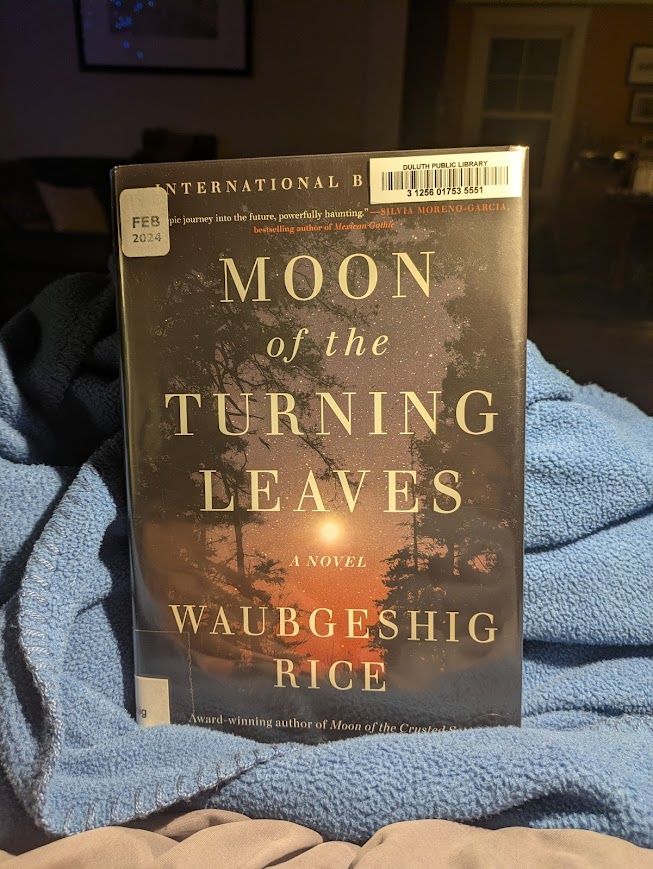
Moon of the Turning Leaves* – Waubgeshig Rice
The sequel to Moon of the Crusted Snow, this novel sees Rice, an emerging writer, find his feet as a storyteller. While the first book sets in action the new realities of a world where the grid has gone down, and the confusion and violence of a newly dystopian society take over, this second novel picks up with the same First Nations characters twelve years later. Having moved from the familiar broken systems of living on a Canadia reserve and returned to indigenous ways, the people are, in the ways it’s possible, thriving. However, the land around them is showing signs of needing a rest from human habitation, and many among the survivors feel a deep pull toward their ancestral homelands near Lake Huron – a place the Anishinaabe were displaced from in the 17th and 18th Centuries. What has happened to humanity beyond the boundaries of their safe life in the forest is unknown, but a small band of survivors decide to risk an exploratory journey back to the lake, a risky walk taking months, with the hope that safe passage can be found for the larger group to eventually migrate Home.
In short: There has never been a better moment for a heartful story of indigenous people finding the way as colonialism falls to messy, catastrophic pieces.
The Heart in Winter – Kevin Barry
It’s the language for me. This novel, set in late-1800s Butte, Montana, and surrounding locations, is a cracker of a love story presented through oft-florid prose, in turns poetic and lurid. My favorite thing when I crack open a novel is when I feel a gush of “Ohhhhh, I’ve never read anything like this before.” Sometimes this feeling of freshness comes through plotting or world building, but when it’s the words themselves that make me straighten my slouch, there is nothing more exciting. Look at the writer write!!
What’s more, Barry’s characters are somehow appealing in their unlikability (They might be third cousins to Bonnie and Clyde), and the fact that they, fatally flawed, love each other profoundly makes their ugly journey beautiful.
In short: The best writers on the planet are Irish. This is not open for discussion.
Honorable Mentions (3.5 stars)
Amity – Nathan Harris
The Last Whaler – Cynthia Reeves
Creation Lake – Rachel Kushner
Fundamentally – Nussaibah Younis
The Voyage Home – Pat Barker
Clytemnestra – Costanza Casati
The Reindeer Hunters, The Night of the Scourge – Lars Mytting
Colored Television – Danzy Senna
Mad Wife: A Memoir – Kate Hamilton
*A book Byron enjoyed, as well


Leave a Reply