
After the appointment with my primary care physician, I messaged my cousin’s wife to report on my experience. As expected, her response was one of exasperation. The hormones available in 2024 were distinctly different from those used in the years of the WHI study, yet the medical establishment, in its conservatism, hadn’t caught up. Complicating matters was the crew of Instagram influencer MDs who were rabidly pushing MHT, often misconstruing study results, leaning into sound bites, or hawking their own supplements, an ethical overstep that linked their often-valid information to a grift for sales. I could see all the points of view, but the one I needed most was that of an ally, and the annoyance of a family member felt like welcome protection.
When I told her my doctor’s stance, she replied, “I disagree. Vaginal estrogen is topical, and in no way systemic. It’s like lotion for the tissues. Using the same argument in reverse, if you use vaginal estrogen why would you need transdermal? That’s ridiculous because vaginal estrogen is topical. Interestingly, in Europe you can buy vaginal estrogen over the counter. I’d push back and ask for a Rx for vaginal estrogen. Where’s the research that says there is no need for vaginal estrogen if you use HRT? And is there any research that shows it would be harmful or ineffective?”
Buoyed by her indignation, I logged into the patient portal and wrote a message gently questioning the PCP’s refusal to prescribe vaginal estrogen. Perhaps I hadn’t been clear enough that I wasn’t asking for a second form of systemic estrogen? Perhaps prescribing vaginal estrogen would be new for her but possibly a good shift in her practice?
Her reply came in the form of a phone call as I was walking into the YMCA to meet a friend. Flustered because I talk on the phone so infrequently and rarely notice incoming calls, I stammered hello.
My doctor didn’t stammer as she explained she’d seen my message and, to her credit, wanted to speak to me directly to stress again that she absolutely would not prescribe vaginal estrogen in addition to transdermal. Her voice rising in frustration just as I entered the foyer of the Y, she blurted, “You could clot out!”
Wow. We really were speaking different languages. Not only is vaginal estrogen purely topical, transdermal estrogen’s risk of causing clots is similarly negligible since it bypasses the liver. We were at an impasse. Mustering a final (hollow) response, I thanked her for reaching out and said that even though we disagreed, she should be assured that I respected her for being the doctor that she was.
We’d barely hung up before I started sobbing. It. Was. Just. So. Frustrating. And trying to communicate my wishes had ended up feeling like conflict with someone I had long appreciated. Were we breaking up?
The hormone specialist is a popular woman in our city, known for her relational skills, personal history with breast cancer, and ability to handle complex cases with acumen. When I called to schedule an appointment, she was booking months out.
In the interim, I applied the low-dose transdermal patches prescribed by my primary—so easy and small!—and cycled progesterone pills, three weeks on, one week off. Within days, I felt my brain snap back into place. Instead of feeling like half of every paragraph in my head had been redacted, I could recall words, track thoughts, finish telling a story. Even though I felt surprisingly fatigued every morning, my sleep quality skyrocketed.
After a few weeks, I realized that all the online doctors were saying they personally took progesterone before bed, as it makes people drowsy. Ahhh, okay. Noted. Once I ignored the “first thing in the morning” instructions my primary had requested for the label of the bottle and switched the timing of the pill, my sleep became even deeper, my brain more refreshed.
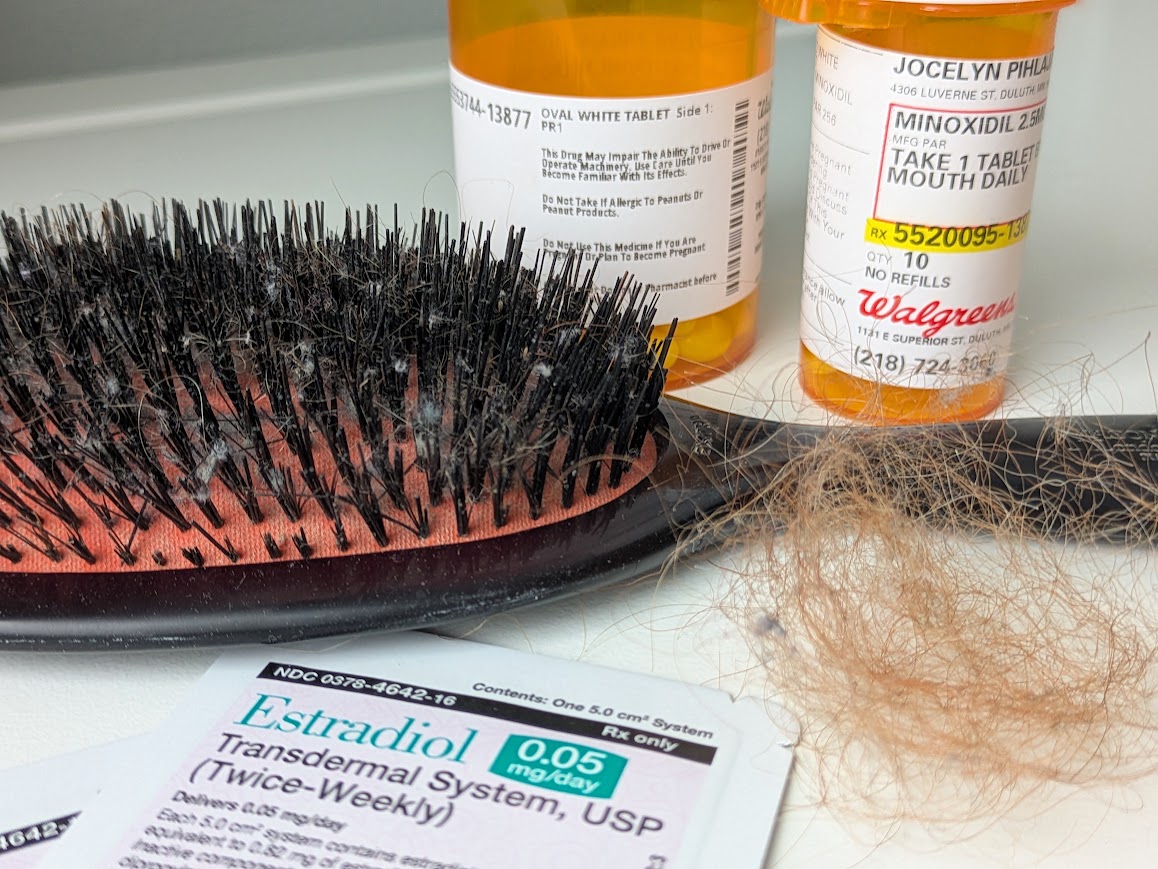
Unfortunately, having clarity of thought made it easier to notice another effect of the hormones: my hair had started falling out constantly, wildly, unreservedly.
Clogging the bristles of my brush: there was my hair.
Curled up like a dead vole in the drain of the shower: there was my hair.
Weaving around the brush roll in the vacuum cleaner: there was my hair.
Covering my pillowcase, running down the back of my sweater, coating the car seat: there was my hair, my hair, my hair, the long red-gold stuff that had served as armor against a judgmental world for as long as I could recall. From the time I entered school, people had offered complaints about my body and my face, but the one thing that had always received approval was the thick energy of my hair. This loss wasn’t just physical; it was emotional and psychological.
Curiously, estrogen is usually thought to make a woman’s hair lusher, but in some cases, the opposite happens. As it turned out, one of my body’s responses to the reintroduction of estrogen was androgenetic, the hair fall mimicking male-pattern baldness.
If I stuck to the hormones I’d fought for, I’d be Larry David by the time I hit 60.
The day I walked into the office of the “hormone expert” OB-GYN, I still hadn’t fully clocked the severity of what was going on with the follicles on my head. Rather, I was nervously expectant. Would this doctor affirm my commitment to the good I believed MHT could do for me in the long term? Or would she align with my primary physician’s point of view and tell me the deep sleep and mental clarity I’d been experiencing had an expiration date?
From the moment the doctor—dense, long, curly hair bouncing—entered the room, my fears quieted. She was…extraordinary? Eyes bright, face attentive, listening to my story like a therapist, her knowledge clear and accessible, this physician was charisma in a white coat.
When I relayed my frustration about being denied vaginal estrogen, she all but tutted with concern. “Of course you need vaginal estrogen!” she exclaimed. “Even I, and I’ve had breast cancer, use it, and I prescribe it for all types of patients.” Within minutes, she was miming the steps she went through to insert the cream – “Some women like the plastic applicator, but I prefer my finger. So just put a dollop on the end of my pointer like this and then squat a little while I push it up and in. Then I take a little more and apply it to the external parts, too, rubbing it in like a lotion. Those vaginal tissues get dry as our hormones change, so we for sure want to do what we can to prevent tearing and UTIs.”
Now this was what I’d been talking about. I almost clapped my hands with joy at the easy affirmation in her response. Even more, she suggested a slightly higher dose of transdermal estrogen, a continuous rather than disrupted cycle of progesterone, and, after hearing about the interactions with my primary physician, told me to hang on a minute while she ran down the hall to print a couple papers explaining the current thinking surrounding MHT. “These might be helpful, if you want to hand them to your primary,” she told me, searching her desk for a stapler.
Before wrapping up, just as I was contemplating tackling her with a hug, she asked, “Anything else?”
Well, yes, two things: it seemed maybe like my hair was falling out, and I wondered also if it would make sense for me to try a little testosterone to round out my hormone cocktail?
She didn’t even have to think. “Testosterone is certainly an option, but if you’re already worried about hair loss, I’d say let’s hold off on it for now, as it can cause hair fall, too, and you don’t want that. As far as what you’re already experiencing with your hair, this does happen to some women when they reintroduce hormones, sometimes for a short period, sometimes for longer. With us boosting your transdermal estrogen, you might see a difference once it hits your system. If not, just message me, and we can prescribe something to combat the hair loss.”
I floated out of the office that day, giddy, hopeful, optimistic.
(Part Four coming tomorrow!)
Leave a Reply